








AN $80 MILLION PLOT TWIST FOR DOCUMENTARY FILM
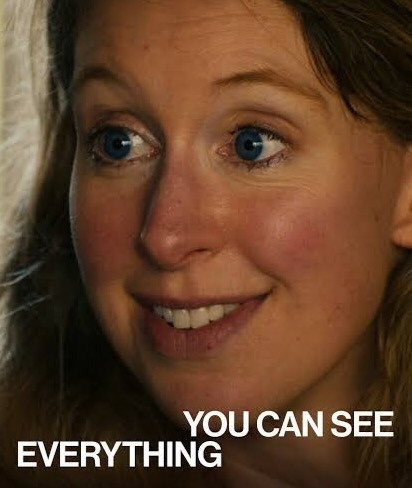
back to listYOU CAN SEE EVERYTHING, the return of ALI G, and a new documentary festival in Ojai California are challenging assumptions about what nonfiction can be—and who will watch it. A nearly three-hour documentary about convicted fraudster Elizabeth Holmes might once have sounded like a difficult proposition for movie theaters. YOU CAN SEE EVERYTHING has made it a phenomenon impossible to ignore. This improbable film, which was almost abandoned by its directors while being shot in secret over three years for about $7 million, became the No. 1 movie in America.
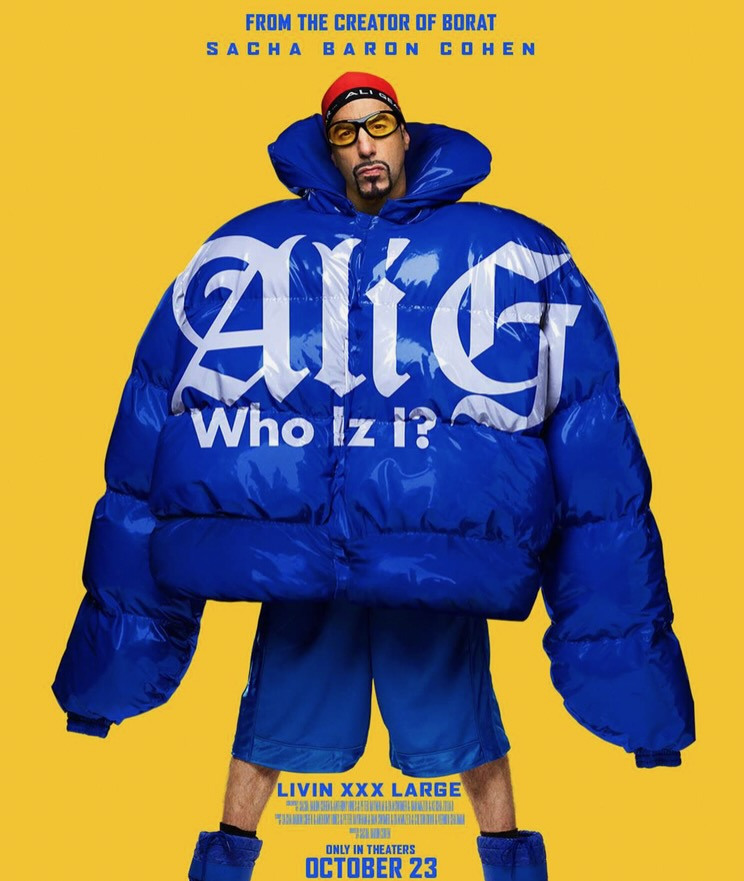
And a week later, a "documentary-style" film directed by Sacha Baron Cohen, starring an absurd character who doesn't exist, hit by a supposed worldwide boycott campaign before anyone had seen it, shot to the top of Amazon Prime Video's charts on both sides of the Atlantic.
As of November 9, Nathan Fielder and Lance Oppenheim’s A24 film with Elizabeth Holmes had collected $79.8 million in North America, according to Box Office Mojo. That's an extraordinary audience for a film whose attributes include discomfort, uncertainty, and a refusal to behave quite as viewers expect.
In a documentary world struggling to finance and distribute work outside a handful of favored categories, the implications could be tantalizing. Will this audacious film change the industry’s understanding of what audiences want? And could such a change go beyond one exceptional success?
This is not an unbiased account. SmithDehn LLP was production counsel on YOU CAN SEE EVERYTHING. We had the same role in Sacha Baron Cohen’s ALI G: WHO IZ I?, which delivered its own pointed response to predictions about what audiences will—or should—watch. Both films are challenging conventional wisdom. Here, we speak only for ourselves as film and television attorneys and producers, not on behalf of any client.
The numbers behind YOU CAN SEE EVERYTHING cannot be dismissed as mere opening-weekend curiosity. Its North American box office receipts already have overtaken the approximately $77 million earned by MARCH OF THE PENGUINS, and they are on track to exceed FAHRENHEIT 9/11’s pathbreaking $119 million for a documentary not about mega celebrities, serial killers, or pop music stars. With a budget reported to be approximately $7 million, the commercial success of YOU CAN SEE EVERYTHING is turning heads.
Critical enthusiasm helps explain the staying power. The Guardian’s Adrian Horton called it “a stupefying and gloriously destabilizing hall of psychological mirrors.” TheWrap’s Adam Chitwood described “a form-shattering film about the very nature of truth and deception.”
And its viewers are well beyond the audience traditionally imagined for a serious documentary. The Associated Press reported that more than 70% of the opening-weekend audience was under 35. A generation routinely discussed in terms of shrinking attention spans bought tickets to spend almost three hours with the opposite of an action film. That might make anyone commissioning nonfiction pause before deciding that complexity is a commercial liability.
The timing matters, because the wider documentary market has offered filmmakers plenty of reasons to be discouraged. For example, there has been a striking disconnect between awards recognition and distribution. Even documentaries that won or were shortlisted for Oscars have struggled to secure U.S. releases. Director Jeanie Finlay summed up the mood: the so-called golden age of documentary "looks a lot like the golden age of true crime and celeb vehicles." Former BBC Storyville executive Mandy Chang has warned of a "corporate age" of documentary.
YOU CAN SEE EVERYTHING offers grounds for optimism, even while the lesson may require some care. Elizabeth Holmes is famous. Her story does relate to alleged crime for which she was convicted. Fielder has a substantial following. The film plainly benefits from ingredients that buyers already recognize.
Its achievement lies, however, in what Fielder and Oppenheim have done with those advantages. A familiar subject becomes an invitation to an unfamiliar experience. The film’s length, ambiguity, and formal daring have proved compatible with a substantial theatrical audience. Recognition may help persuade people to look, but originality can give them a reason to keep watching, argue afterward, and bring someone else. It is also worth noting that in TheWrap's audience polling, 70% of viewers said Fielder himself was a major reason they bought a ticket. The draw wasn't access to the famous Elizabeth Holmes. It was a filmmaker's point of view — a voice, a form, a sense that you were going to see something you'd never seen before.
A24’s release strategy helped turn that originality into an occasion. As TheWrap documented, the surprise Telluride premiere, tightly controlled advance information, and intriguing teaser created urgency around discovering the film. Writing in The Atlantic, David Sims identified the film's victory succinctly: the filmmakers and distributor had turned a documentary into “a narrative event.”
The film’s awards ambitions raise the stakes further. A24 is explicitly campaigning for a Best Picture Oscar, alongside Best Documentary and other categories. A Best Picture nomination would be historic: as the Associated Press notes, no documentary has previously been nominated for the Academy’s top prize. A24's gambit is not a vanity push. Variety has predicted a Best Picture nomination.
The proposition challenges a persistent hierarchy: nonfiction gets its own less celebrated category, while the principal contest for cinematic greatness has remained the preserve of scripted films. YOU CAN SEE EVERYTHING invites voters to consider its direction, construction, and impact on the same terms as any other movie. A nonfiction film competing head-to-head with the year's scripted tentpoles would be a genuine first — and a signal to every financier who has ever filed documentaries under "niche."
Another film related to Fielder’s creative world is unsettling a different set of assumptions.
The connection between Fielder and Sacha Baron Cohen goes beyond their shared willingness to create exquisitely uncomfortable filmed encounters. They worked together on WHO IS AMERICA?, sharing a 2019 Emmy nomination for directing an episode of the series. Fielder also was a contributor to Cohen's BORAT: SUBSEQUENT MOVIEFILM, the most-watched film of 2020. Discussing Fielder's most recent film with Vanity Fair this last month, Cohen heaped praise on his collaborator, saying “He’s really reinvented the genre.”
Both filmmakers understand how much can be revealed when people are invited into a situation whose rules they do not fully understand. Their work also asks viewers to scrutinize the person arranging that situation. The resulting films occupy territory that familiar labels—comedy, documentary, performance, satire—describe only partially. If YOU CAN SEE EVERYTHING blurs the line between documentary and drama from one side, ALI G: WHO IZ I? charges at it from the other.
Both films were shot in secret. Both put real people into constructed situations and let the camera roll. Both make the audience complicit in the question of what's staged and what's real. And both are defying the labels the industry tries to put on them: a documentary chasing Best Picture, and a comedy that a documentary festival embraced as one of its own.
After an AI-assisted, mostly fabricated "backlash" campaign of dubious origins caused many to believe that ALI G: WHO IZ I? would be nothing more than an outdated, embarrassing flop, Sacha Baron Cohen responded to the campaign with his trademark style of satire, re-appearing as his bigoted Borat character to enthusiastically join in the boycott. Going even further, wearing prosthetics as a fictional activist from the "Campaign for Ethical Comedy," Cohen again urged fans to boycott his own movie. The ALI G film rocketed to Number 1 on Amazon Prime Video in the United States, the United Kingdom, Ireland, Canada, Australia, and six other countries.
The challenges to received wisdom and conventional categories on the part of both YOU CAN SEE EVERYTHING and ALI G found an especially appropriate setting at the inaugural Ojai Documentary Film Festival in October 2026.
Organized by SmithDehn clients Eric Goode and Jeremy McBride in collaboration with Ojai Playhouse owner David Berger, the festival launched at the former's beautifully restored, iconic Hotel El Roblar, bringing filmmakers and audiences together around an unusually expansive conception of nonfiction. Goode and McBride’s unique experience includes brazen successes like TIGER KING, CHIMP CRAZY, and MONSTERS OF GOD. Their new festival combines that appetite for extraordinary real-life stories with the intimacy of the revitalized Playhouse and next-door Hotel.
At its sold-out, closing night presentation in Ojai, ALI G: WHO IZ I? was billed as a documentary—a revealing reception for a film often described as a “mockumentary.” Ali G is an invented character. But the behavior his encounters elicit can nevertheless tell us much that is real. The category becomes a starting point for discussion.
Festival founder Goode has said the best documentaries introduce you to a world you didn't know existed, and that the truth usually turns out stranger than anything you could invent. Few films test that idea like Ali G: Who Iz I? — presented as part of a long, honorable tradition of filmmakers provoking real people into revealing themselves on camera.
Openness is central to Ojai’s promise. Its stated remit embraces vérité, hybrid forms, and “the wholly unclassifiable.” Its program this year included YOU CAN SEE EVERYTHING alongside work by other accomplished filmmakers like Alex Gibney, Ross McElwee, Joan Churchill, Lauren Greenfield, Matt Wolf, John Wilson, Tamra Davis, and Luke Lorentzen.
“We believe event-driven programming is the future of cinema,” McBride said in the festival announcement. The idea has practical force: a screening becomes a meeting place, a conversation, and a reason to leave the house.
Ojai also made room for the less glamorous questions that determine whether ambitious films reach that audience. Its program addressed sustainable financing and the legal pressures facing documentary filmmakers, with SmithDehn participating in a panel discussion titled "See You in Court: Documentaries Under Fire." We'll be back next year.
Meanwhile, an exceptional box-office run cannot, by itself, repair the documentary business. A streaming chart cannot tell us which unfamiliar filmmaker will secure funding next. The consequential decisions still belong to financiers, distributors, exhibitors, and programmers: whether they respond to these successes by widening their expectations. They now have some compelling reasons to do so.
YOU CAN SEE EVERYTHING is drawing crowds while testing documentary’s boundaries. ALI G: WHO IZ I? has found a massive streaming audience amid arguments about whether it should be shown at all. The Ojai Documentary Film Festival has created a new gathering place for films that resist easy classification. And for anyone purporting to decide which films deserve a chance, the larger audience has supplied some truly surprising plot twists.